
Self-Regulation in Kids: What It Is & How to Build It
Self-regulation in children develops fastest between ages 3–6. Here's what the science says—and the calm, concrete steps parents can take today.
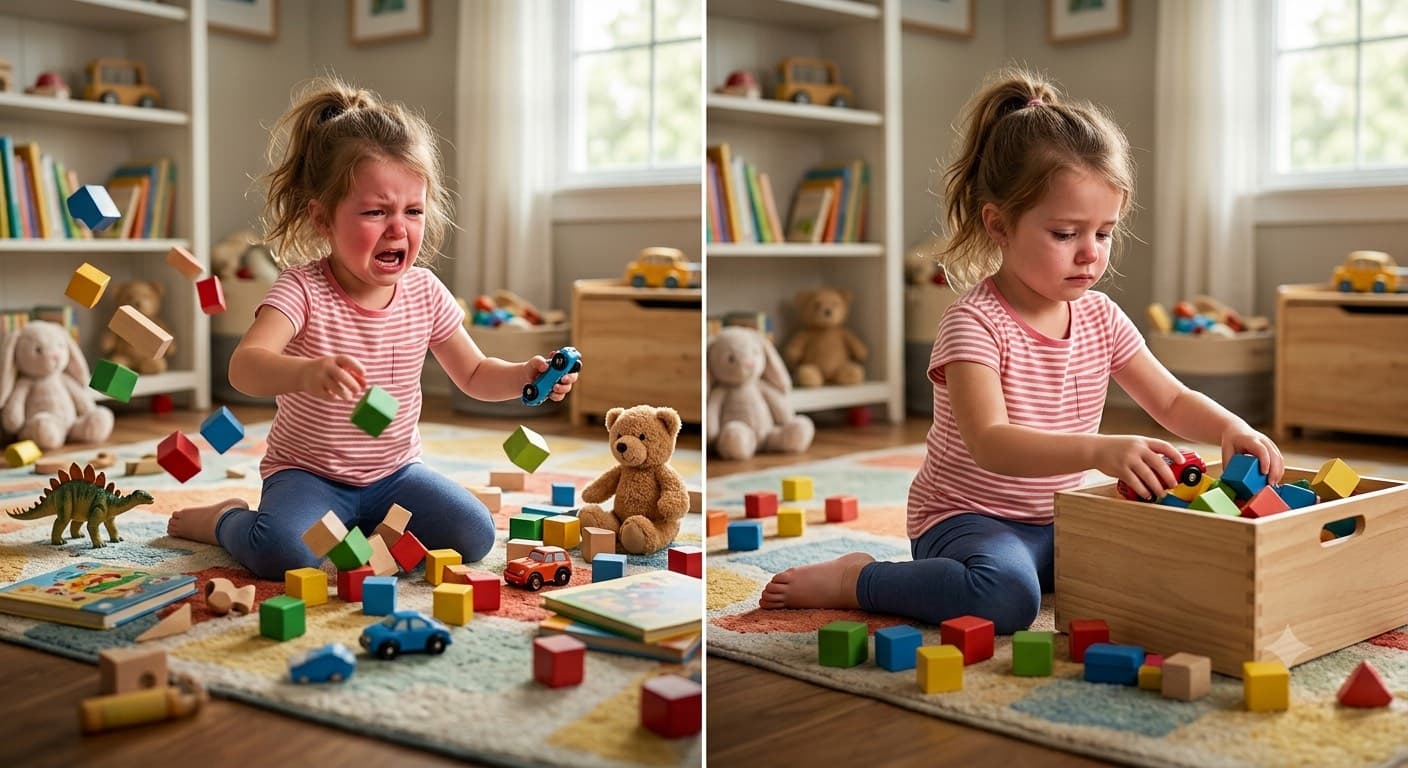
Quick answer: Self-regulation in children is the ability to manage emotions, impulses, and behavior—and it develops most rapidly between ages 3 and 6. Parents build it not by demanding kids "calm down," but through co-regulation: staying regulated themselves, naming what the child is feeling, and gently coaching them through the hard moment. The good news? Small, everyday interactions add up to lasting change.
The Moment Every Parent Recognizes
It's 5:47 p.m. Dinner is burning. Your child is on the floor because their cracker broke. You know—rationally, completely—that this is not about the cracker. But knowing that doesn't make the next two minutes any easier.
Those moments aren't a sign that something is wrong with your child, or with you. They're a sign that your child is doing exactly what children ages 3–7 are supposed to be doing: learning, slowly and messily, how to manage big feelings. That learning doesn't happen automatically. It happens with you.
What Self-Regulation in Children Actually Means
Self-regulation is the ability to notice an internal state—frustration, excitement, disappointment—and respond to it in a way that fits the situation. It covers emotions, yes, but also attention, impulse control, and behavior. A child who can wait their turn, take a breath before grabbing a toy, or say "I'm mad" instead of hitting is exercising self-regulation.
It is not the same as being compliant or quiet. A regulated child can still feel intensely. The difference is that they have—or are building—some capacity to work with that intensity rather than be hijacked by it.
Crucially, self-regulation is not a character trait children are born with or without. It is a skill, and like all skills, it is taught.
The Science: Why Ages 3–7 Are the Window That Matters
A large accelerated longitudinal study published in Developmental Science (Hosch, Oleson et al., 2022) tracked children across the preschool and early elementary years and found that self-regulation shows its steepest developmental growth between ages 3 and 6—with substantially less dramatic gains after that window. This doesn't mean older children can't improve; it means the early years are when the soil is most fertile.
The brain science explains why. The prefrontal cortex—the region responsible for planning, impulse control, and emotional regulation—is under heavy construction during these years. When a child is flooded by a big feeling, the amygdala (the brain's alarm system) fires before the prefrontal cortex can apply the brakes. That's not defiance. That's developmental biology.
Here's the encouraging part: parents can actually help build those brakes. Research by Lieberman and colleagues (2007, Psychological Science) found that simply labeling an emotion—putting a word to a feeling—measurably reduces amygdala activation and increases activity in the prefrontal cortex. The act of naming a feeling ("You're frustrated right now") triggers the brain's own regulatory system. No elaborate intervention required.
Why Emotion Coaching Is the Engine
John Gottman's longitudinal research on what he called the "meta-emotion philosophy" offers some of the most robust evidence in this space. In a three-year study of preschool-aged children, Gottman, Katz, and Hooven (1996) found that parents who practiced emotion coaching—acknowledging, labeling, and helping problem-solve their children's negative emotions—raised children with significantly better self-regulation. Those same children went on to show stronger academic achievement and better peer relationships, as rated by their teachers.
Emotion coaching isn't about fixing every feeling. It's about treating your child's emotional moment as an opportunity for connection rather than a problem to eliminate. Spinrad, Eisenberg, and colleagues (2006, Emotion) separately found that children's ability to regulate emotions in preschool predicted their social competence and peer acceptance at follow-up—controlling for temperament and family factors. In other words, the emotional skills your child builds now ripple outward in ways that matter for years.
For a deeper look at how this works in practice, our post on what emotion coaching is and why it matters walks through the framework in detail.
How to Build Self-Regulation: Six Things to Try Tonight
These aren't overhauls. They're small, repeatable moments that compound over time.
1. Name the feeling out loud
When your child is upset, narrate what you see before you try to fix anything: "I can see your body is really upset right now. That feeling is called frustration." This is the "name it to tame it" technique, grounded in Lieberman et al.'s neuroscience—labeling activates the prefrontal cortex and turns the volume down on the amygdala. You're not dismissing the feeling; you're giving it a handle.
2. Regulate yourself first
Your nervous system talks to your child's nervous system before either of you says a word. This is co-regulation: your calm becomes a resource your child can borrow. Take one slow breath before you respond. Lower your voice rather than raising it. Your child's brain is watching yours for cues about whether this moment is survivable. Our post on co-regulation and how parents build self-regulation in kids goes deeper on the neuroscience behind this.
3. Expand the feelings vocabulary
Children who only have "mad," "sad," and "happy" are working with a blunt instrument. Help them find more precise words—frustrated, disappointed, nervous, overwhelmed—because precision matters for regulation. The Mood Meter approach from Yale's RULER program offers a simple two-question prompt you can try at any age: "Does it feel good or not-so-good? High energy or low energy?" Then name the emotion together. Rivers and Brackett (2010) found that preschoolers in RULER classrooms showed significantly greater emotion recognition and labeling than those who weren't. For more on building this vocabulary, see feelings words for kids.
4. Practice Gottman's emotion coaching in five steps
When a big feeling arrives: (1) notice and name the emotion, (2) treat it as a moment for connection, (3) validate—"It makes sense you're upset, you really wanted that"—(4) help find words, and (5) problem-solve after the storm has passed. The order matters. Problem-solving during a flood rarely lands.
5. Play stop-and-go games
Freeze Dance. Simon Says. Red Light, Green Light. These games look like pure fun, but they are actually practicing the exact executive functions that underpin self-regulation: inhibitory control, working memory, and attention. A randomized controlled trial by Tominey and McClelland (2011, Early Education and Development) found that eight weeks of structured circle-time games produced significant self-regulation gains in preschoolers—with the largest gains for the children who started with the lowest baseline scores.
6. Teach belly breathing during calm moments
Practice it at bedtime or in the car—not just mid-meltdown. "Let's blow up our tummy like a balloon, then slowly let the air out." A preregistered randomized study in Developmental Science found that a brief deep-breathing intervention significantly reduced physiological arousal in children in real-world settings. The key is practice when the stakes are low, so the tool is available when the stakes are high.
How Stories Fit Into All of This
Here is something that often surprises parents: children don't just enjoy books about feelings. They learn from them.
A 2023 study published in PLOS ONE (Schoppmann et al.) gave three-year-olds a picture book in which a same-aged character used a distraction-based strategy during a frustrating waiting task. Compared to children who read a control book, those children were significantly more likely to use that same strategy themselves when they faced a real, frustrating situation right after. The book didn't just model the behavior—it transferred it.
This is why shared reading is more than a bedtime ritual. When you pause on a page and ask, "How do you think she's feeling right now? What could she do?", you're running a live, low-stakes emotion coaching session. The character holds the big feeling so your child can observe, name, and think—without being in the middle of their own storm.
The Long Game
Self-regulation in children is not something that clicks into place after one good week. It's built in hundreds of small moments—a feeling named at dinner, a breath taken before a response, a book read on a Wednesday night for no particular reason.
Gottman's research is clear: parents who make a habit of engaging with their children's emotions—not avoiding them, not immediately correcting them, just acknowledging them—raise children who are more resilient, more socially successful, and more ready for school. And if today was a five-cracker-level disaster? There's always tomorrow's dinner.
Frequently asked questions
1.What is self-regulation in children?
Self-regulation is a child's ability to manage their emotions, thoughts, and behavior in response to a situation. It develops gradually through early childhood, with the biggest gains happening between ages 3 and 6.
2.How can parents help children develop self-regulation?
Parents build self-regulation through co-regulation—staying calm themselves, naming feelings together, and coaching children through hard moments rather than dismissing or punishing emotions. Gottman's emotion coaching research shows this approach produces lasting gains.
3.At what age do children develop self-regulation?
Research shows the steepest growth in self-regulation happens between ages 3 and 6, making the preschool and early elementary years the highest-impact window for parent support.
4.What is co-regulation and why does it matter?
Co-regulation is when a calm, connected adult helps a child manage a big feeling they can't yet handle alone. It's the stepping stone that eventually becomes a child's own self-regulation ability.
5.Can reading books help children with self-regulation?
Yes. A 2023 study found that 3-year-olds who read a picture book featuring a peer using an emotion-regulation strategy were more likely to use that same strategy themselves during a frustrating real-world task.
Ready to Create Your Child's Story?
Every Sprig book is personalized to your child's specific emotional needs — backed by the research you just read about.
Create Your Book