
How to Help an Angry Child Calm Down (When "Just Calm Down" Doesn't Work)
Telling an angry child to "just calm down" rarely works — and neuroscience explains why. Here's a calm, research-backed way to help your child through big anger, step by step.

Quick answer: Telling a child to "just calm down" rarely works because, during big emotions, the brain's alarm system (the amygdala) takes over and the thinking brain goes offline. The fastest way to help is co-regulation — staying calm yourself, naming the feeling, and offering steady, connected presence until your child's nervous system settles.
Why "just calm down" can't work
When a child is flooded with anger, the amygdala — the brain's alarm system — takes over. The prefrontal cortex, responsible for reasoning and self-control, temporarily disconnects. Asking a child to reason their way out of anger is like asking them to read in the dark. The lights are off.
Harvard's Center on the Developing Child describes emotional regulation as a function of three interconnected brain systems: the prefrontal cortex (logic), the amygdala (emotion), and the brainstem (survival). In young children, these circuits are still under construction. When a big feeling hits — a tower falls, a sibling grabs a toy — the emotional brain floods the system and rational thought simply isn't available.
This isn't a parenting failure. It's developmental biology. And it's the same neuroscience behind the Gottman Institute's work on emotion coaching, built on 40+ years of research.
What to do instead: co-regulation, step by step
- Regulate yourself first. Your calm is contagious — your child's nervous system borrows it. Lower your voice and slow your breathing.
- Get down to their level. Physical presence signals safety before any words land.
- Name the feeling. "You're really angry the tower fell." Labeling an emotion activates the prefrontal cortex and begins calming the amygdala — scientists call this "name it to tame it."
- Wait for the wave to pass. Don't problem-solve mid-storm. Stay close.
- Then teach. Once calm returns, explore what happened and what to try next time.
The sequence the research points to is simple but profound:
Parents co-regulate → children internalize those strategies → children eventually self-regulate.
It takes time. It takes repetition. It takes you, again and again, choosing calm when they can't.
Why this matters beyond the tantrum
Research from longitudinal studies shows that children who develop strong self-regulation skills in early childhood go on to have better academic outcomes, healthier relationships, and lower rates of anxiety and substance use in adulthood. The payoff from those calm, unglamorous moments in your kitchen is enormous — even if it doesn't feel like it at the time.
Why stories make this easier
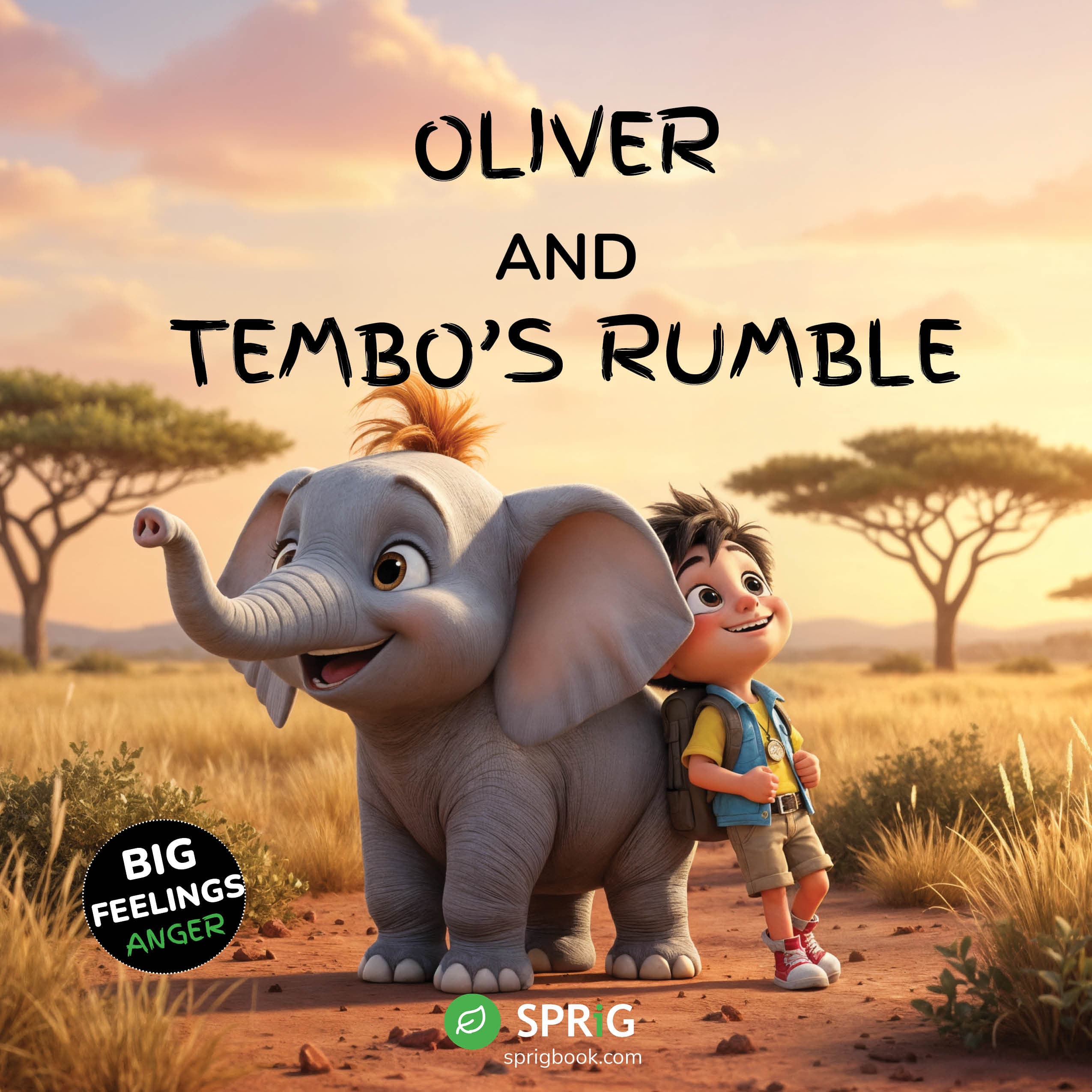
Children learn anger tools best before the storm hits — in calm, connected moments. Reading a story about a character working through anger gives your child a safe rehearsal space: they practice the feeling and the tools without being overwhelmed by them. This is the principle behind bibliotherapy, and it's exactly how Sprig books are built.
Frequently asked questions
1.Why does my child get so angry over small things?
Big reactions to small triggers are normal — a child's developing brain feels intensely while still building the wiring for self-control. It's a sign of development, not misbehavior.
2.Is it bad to give a child space when they're angry?
Brief space can help, but young children regulate best with a calm adult nearby (co-regulation), not alone. Stay available.
3.How do I stay calm when my child is melting down?
Slow your own breathing, lower your voice, and remind yourself the behavior is a brain state, not defiance. Your regulated state is the tool.
4.Can books really help with anger?
Yes — narrative-based interventions are shown to improve children's emotional understanding. Stories let kids rehearse feelings and coping tools in a safe context.
Ready to Create Your Child's Story?
Every Sprig book is personalized to your child's specific emotional needs — backed by the research you just read about.
Create Your Book